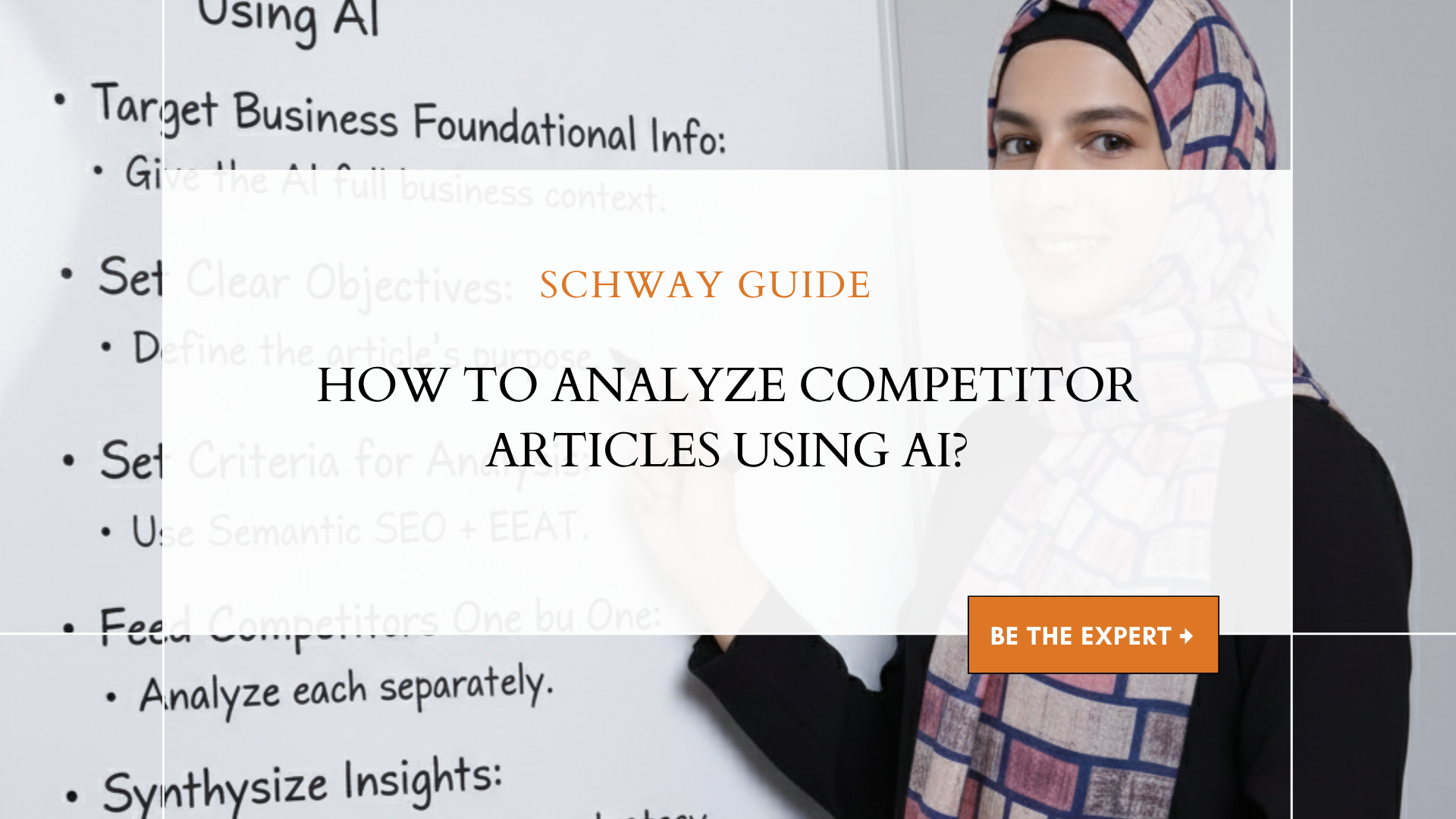
You need to understand that competitor content analysis is not limited to checking headings, skimming definitions, or pulling a few ideas from the SERP. It goes far beyond that.
It involves studying how competitors structure meaning, satisfy intent, use entities, position expertise, explain concepts, guide the reader, connect ideas, and miss depth that the topic demands. Each aspect shows you what the topic truly requires and where your article can outperform.
But, how to do it all smartly and fastly? Of course, you need to use AI like a pro. So, now I’m going to teach you how I learn from and use competitor insights with the help of AI.
Step 1 — Target Business Foundational Info: You Must Feed it to the AI Beforehand
Before you ask an AI tool (such as ChatGPT) to analyze competitor articles, you must guide it about your business and the purpose of the content. Because the AI evaluates everything through the context you provide.
If the AI receives no understanding of your business model, audience, or service focus, it produces analysis that lacks depth, misses relevant angles, and repeats generic competitor claims. Strong competitor analysis depends on precise context.
The AI must know who you are, who you serve, what you offer, and what the article aims to achieve. Once this information is supplied, the AI can recognize what matters to your market, spot gaps competitors overlook, and recommend ideas that align with your positioning instead of drifting into broad, unfocused commentary.
This step builds the foundation. The clearer your input is, the stronger the AI’s output becomes.
What to Feed the AI Before Competitor Analysis:
Provide one complete input that covers the following:
- Business description
- Business name
- Location
- Type of company
- Main service categories
- Typical clients
- Industries served
- Problems solved
- Strengths or differentiators
- Target audience
- Job roles
- Seniority
- Pain points
- Desired outcome after reading
- Purpose of the article
- Primary reader objective
- Secondary business objective
- Evidence boundaries
- Approved sources
- Claims to avoid
- Approval or compliance constraints
- Product naming rules
- Terminology requirements
- Statements that require accuracy checks
This information gives the AI the correct frame for evaluating competitor content.
Example Master Prompt
Below is an example of how a writer should prepare the foundational information before feeding competitor articles to the AI.
Example Prompt to Give the AI
We need to write a detailed guide on “6 Major Salesforce Clouds: Features, Differences, Architecture and When to Use Each.”
The business is called StratusRev Consulting, a UK-based Salesforce advisory firm. It provides Salesforce architecture, cloud selection guidance, revenue operations design, technical remediation, and platform optimisation. The firm supports mid-market and enterprise organisations in technology, finance, professional services, and operational industries. Clients often face inefficient configuration, fragmented data, poor adoption, and uncertainty about which Salesforce Clouds align with their commercial model. The consultancy addresses these issues through structured audits, corrective architecture, and hands-on system improvements. Its strengths include deep platform expertise and a diagnostic-first approach.
The target audience includes Heads of Revenue, IT Managers, Operations Leaders and Transformation Directors who require clarity before finalising Salesforce Cloud decisions. These readers want practical explanations and reliable guidance that avoids technical jargon.
Approved evidence sources include official Salesforce documentation, release notes, and reputable ecosystem publications. The content must avoid speculative product claims and must use official Salesforce product names.
When asked, you must analyze the competitor articles I provide and identify gaps, strengths, weaknesses, and opportunities based on the business information above.
Step 2 — Set Clear Objectives for the Article Before Analyzing Competitors
Competitor content analysis only works when the article’s purpose is fixed beforehand. AI tools compare competitor content against the goal you define. If the goal is vague, the comparison becomes vague. If the objective is precise, the analysis becomes targeted and meaningful. This step prevents you from drifting toward whatever competitors wrote and keeps the article aligned with your own strategy.
Writers often skip this step and allow competitors to shape their direction. This leads to content that copies the market instead of positioning the business correctly. A clear objective gives the AI a stable reference point. The tool evaluates whether competitors help or hinder your goal, where they fall short, and where your article can stand apart.
Article objectives fall into two categories: reader objectives and business objectives. Both must be defined before you ask the AI to review any competitor source.
What You Must Define for Article Objectives:
- Reader objective
You need to state what the reader wants to achieve or learn, as this objective guides tone, level of detail, and depth.
- gain clarity about a technical decision
- understand differences between similar solutions
- remove confusion about pricing or product structure
- learn a framework to guide a business process
- assess whether a tool or method fits their organisation
- Business objective
You need to state what the article must do for the business, as this objective guides angle, structure, and emphasis.
- establish the firm’s authority
- clarify misconceptions in the market
- steer readers toward a consultation
- position a service as the correct next step
- highlight gaps the business uniquely solves
- Scope
In fact, you also need to define what the article will cover and what it will exclude. Because a clear scope prevents unnecessary comparison and keeps the analysis tied to your intent. - Positioning stance
It is also important to clarify where you want the article to sit in the market. Options include practical, diagnostic, strategic, or technical. This helps the AI judge whether competitor content matches or misses your intended stance.
Example Objective Prompt (related to the previous example business)
The article must help senior decision makers understand the six major Salesforce Clouds and how they differ. The reader objective is to gain clarity before deciding which cloud aligns with their organisation. The business objective is to position the consultancy as the specialist that guides cloud selection decisions through structured audits. The scope includes Revenue Cloud Advanced, Sales Cloud, Service Cloud, Marketing Cloud, Commerce Cloud, and Experience Cloud. The positioning stance is diagnostic and advisory, aimed at leaders who require structured reasoning rather than surface-level summaries.
Step 3 — Set the Criteria for Competitor Analysis
Once your business information and article objectives are clear, you need to guide the AI on how to analyze each competitor article. You cannot let the AI decide its own criteria, because it will default to surface-level checks such as headings, word count, or keyword usage. That leads to shallow insights. Instead, you instruct the AI to analyze every competitor based on Semantic SEO and EEAT criteria, because both frameworks determine whether an article has real meaning, depth, authority, and completeness.
Semantic SEO ensures the AI evaluates what the content means, how well it covers essential entities, and whether the article satisfies user intent. EEAT ensures the AI evaluates how trustworthy and expert the content appears. This combination gives you a high-precision analysis that highlights exactly where competitors are strong, where they are weak, and where your article must outperform them.
Sample Prompt for AI — Competitor Article Analysis Using Semantic SEO + EEAT
Analyze the following competitor article using Semantic SEO and EEAT criteria. Evaluate strictly based on meaning, depth, intent coverage, entity usage, clarity, accuracy, and trust. Provide findings in clean bullet points.
Analyze the competitor article for:
- Semantic SEO Factors
- Coverage of primary entities
- Coverage of supporting entities
- Accuracy of definitions and terminology
- Logical grouping of entities based on semantic proximity
- Macro intent coverage (H2-level completeness)
- Micro intent coverage (H3-level completeness)
- Alignment with query networks and People Also Ask patterns
- Depth of explanation (what + how + why)
- Use of examples that strengthen meaning
- Macro → micro → macro structure
- EAV clarity (Entity → Attribute → Value clarity in explanations)
- Missing entities, missing relationships, or missing steps
- Overall semantic completeness vs. topic expectations
- EEAT Factors
- Evidence of real experience (examples, scenarios, grounded use cases)
- Expertise signals (correct terminology, accurate concepts, industry logic)
- Authoritativeness (references, models, frameworks, credible support)
- Trust signals (transparent explanations, factual clarity, no exaggeration)
- Tone and readability (natural, human, not robotic)
- Signs of outdated or incorrect information
- Statements that require fact-checking
- Content Gaps & Opportunities
- Missing sub-topics the user expects
- Misaligned or shallow explanations
- Incorrect or incomplete definitions
- Misplaced sections
- Missing comparisons
- Missing use cases or examples
- Missing internal linking opportunities
- Weak transitions that break meaning
- Final Deliverables
- A clear list of strengths
- A clear list of weaknesses
- A list of semantic gaps
- A list of EEAT gaps
- A list of opportunities for our article to outperform competitors
Step 4 — Feed Competitor Articles One by One
After setting your criteria for Semantic SEO and EEAT analysis, you move to the practical part: feeding competitor articles to the AI. This step must be controlled. Writers often paste multiple articles at once or give unclear prompts, which forces the AI to blend insights, skip details, or misinterpret context. You prevent this by feeding competitors one at a time, using the same analysis prompt for each, so your comparisons stay consistent.
The goal of this step is simple: gather structured intelligence article by article. When each competitor is analyzed in isolation, you later combine the findings and identify patterns—consistent strengths, repeated weaknesses, missing explanations, recurring entities, or opportunities to create something superior.
Before submitting each competitor article, confirm that you paste full content without removing images, diagrams, tables, or author notes. The AI must see everything because EEAT signals sometimes appear in unexpected places, such as author credentials, update dates, citations, disclaimers, or diagrams that strengthen authority.
Once you prepare the article, you deliver it to the AI along with the analysis prompt you created in Step 3. This ensures the AI evaluates all competitors in a uniform way.
Read: How to Research a Topic for Semantic SEO and E-E-A-T Accuracy?
Here is the exact instruction structure you use for each article:
Sample Prompt to Feed Competitor Articles — One at a Time
“Analyze the following competitor article using the Semantic SEO + EEAT criteria we defined earlier. Follow the exact checklist. Do not summarize. Identify strengths, weaknesses, semantic gaps, EEAT gaps, missing intent coverage, and opportunities for us to outperform them.
Here is Competitor Article #1:”
→ Paste the full article here
Once the analysis is complete, save the output and move to the next competitor. You need to repeat the same prompt for each competitor article’s analysis.
Step 5 — Synthesize All Competitor Insights Into One Master Understanding
Once you complete the individual analyses, you have detailed observations scattered across multiple outputs. But all the analyzed insights can give you value only if you combine them into one unified understanding of the topic. This step bridges analysis and strategy.
So, instruct the AI to convert all these cross-competitor patterns into a single strategic foundation for your article. The instruction must be clear because the AI needs to transform raw notes into a structured plan. The goal is to create the ultimate heading structure, the semantic pillars, and the authority signals needed to outperform every competitor.
Sample Prompt — Convert Synthesis Into Final Content Strategy
“Combine all competitor-analysis insights into one master strategy.
Create:
• the ultimate heading structure for our guide
• a list of essential entities we must include
• supporting entities that strengthen depth
• all user-intent questions the article must answer
• all semantic gaps competitors missed
• all EEAT gaps we must fix
• key examples or use cases to include
• keywords and variations based on meaning, not volume
Read: How to Write Semantic SEO and EEAT Approved Articles for Business Website Blogs?
Final Words
Competitor content analysis becomes powerful only when you treat it as a structured process rather than a quick SERP scan. Right?
You now have a complete method: prepare your business context first, define the article’s objectives clearly, set precise Semantic SEO and EEAT criteria, analyze each competitor source one at a time, and synthesize all insights into a single strategic foundation.
If you feel something is missing in your workflow, revisit any step where the inputs were incomplete or where the AI did not receive enough context. Because AI-powered competitor analysis depends entirely on the quality of your instructions.
If you want to refine your process further, add more competitors, expand your semantic entity lists, or adjust your article objectives based on new findings. Each improvement makes your content stronger, more authoritative, and more aligned with user expectation.